
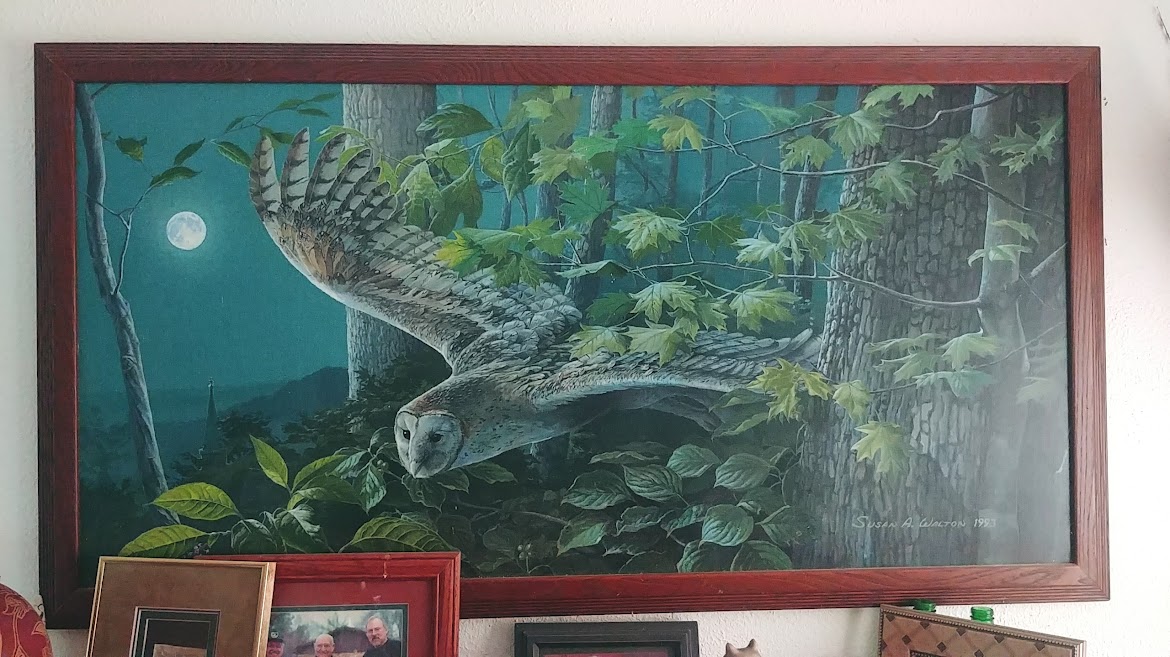
“Guiding Light ~ Barn Owl,” an original acrylic painting copyright Susan A. Walton, S. A. Walton Studio.
A barn owl emerges from an unseen barn at the forest edge to hunt the pastures and fields that are tucked here and there in a countryside of expanding woodlands. Unlike the barred owls that haunt the swamps and deep woods, ghostly barn owls prefer more open country, and so, do better when farmers are actively keeping the trees at bay. But the old wooden barns they frequent and rely on for nesting are, like the farmland, giving way to changing times and changing land use, and are either becoming overgrown or being replaced by modern metal pole barns. We can help them out by hanging nest boxes for them, and they will return the favor by catching rodents.
This painting started out with some pokeweed that popped up in a suburban yard. I plucked a stem of it and took it inside one day to practice painting light’s effects on flowers, fruits and other objects, as I am wont to do when fishing for ideas. After arranging it in a vase and moving the cutting about a light source, I noticed and sketched the various things that are characteristic of the plant that differ from others. Color, a fine satin sheen from minute hairs on the leaves, and the different way light bounced off the stems and berries. In the course of observing these features an idea began to form.
Pokeweed was a plant my grandmother collected every spring on her farm. She boiled it once, then again, to prepare it for eating as a sort of spring tonic. In those days there wasn’t much green stuff to eat once winter set in, and so, when spring came and pokeweed emerged from dormancy, it was prized. After boiling it she sautéed it in bacon grease, which added flavor. She was thrifty and self sufficient, and thankful for little timely blessings like nutritious pokeweed and other foraged things, such as the sassafras my parents dug for her on their place. She loved sassafras tea, but there were no sassafras trees growing on her place. She considered herself blessed, and was grateful for her farm animals and always had a large garden to match.
She would sometimes sing hymns as she worked, and as a child she even wrote a song about a man who would always dismiss an invitation from his brother to go to a church meeting with the words “I’ll come tomorrow night,” but tomorrow night always came and went without him taking the time to pray alongside his brother. Evidently she shared it at some church meeting because I later stumbled upon it in the archives of a university as part of recordings a professor made of traditional Ozark folk singers and fiddlers. In the recording, an elderly man played and sang it in an accent akin to hers with but a few alterations.
While recalling her gentle wisdom, I considered adding a little church in the distance, one that graced a beautiful stream near a low water bridge where smallmouth bass and bluegill lurked in the shadows of overhanging trees. I wish I could add her song as well.
There is dogwood in the scene, though it is no longer blooming. America’s native flowering dogwood has a graceful, tiered form quite unlike nonnative Kousa or Korean dogwood or other trees, so different that I can easily distinguish our species from a great distance. Up close, it is even easier. The leaves come in pairs, one opposite the other, and they are rather simply shaped, very broad ovals with a veining pattern unlike most simple leafed trees. The “flowers” are a not so much made of petals but rather, four white bracts with a hint of pink, and deep indentations or what are likened to bleeding nail-holes in the distal ends of the usually creamy white bracts. These very large “flowers” are traditionally considered emblematic of Christ’s crucifiction, and tend to bloom at the same time as the Eastern redbud tree, a which for some reason is sometimes dubbed the Judas Tree.
One spring when we were walking in the woods admiring the hot pink redbud blossoms, and the ethereal layers of flowering dogwoods, grandmother picked a dogwood branch and told me about the symbolism of the dogwood flowers, thus ensuring that as long as I live, the sight of a dogwood in bloom would remind me not just of her, but of my Savior’s selfless love.
I enjoy the challenge of painting different species of trees so that they are recognizable, and in this artwork I tackled the sugar maple, the dogwood, sassafras and muscle wood, all very common, like the poke weed, in the southern Missouri of my youth. As a final touch, I added the familiar steeple of the little Lutheran church in the distance whose bell would echo across the valley, calling distant congregants to come down to the church on Cedar Creek.
#Art #OriginalArt #GuidingLight #BarnOwls #Pokeweed #Steeples #Christianity
- Medium
- Acrylic
- Substrate
- Hardboard, plain
- Dimensions
- 24 x 48 x 1/4 in