
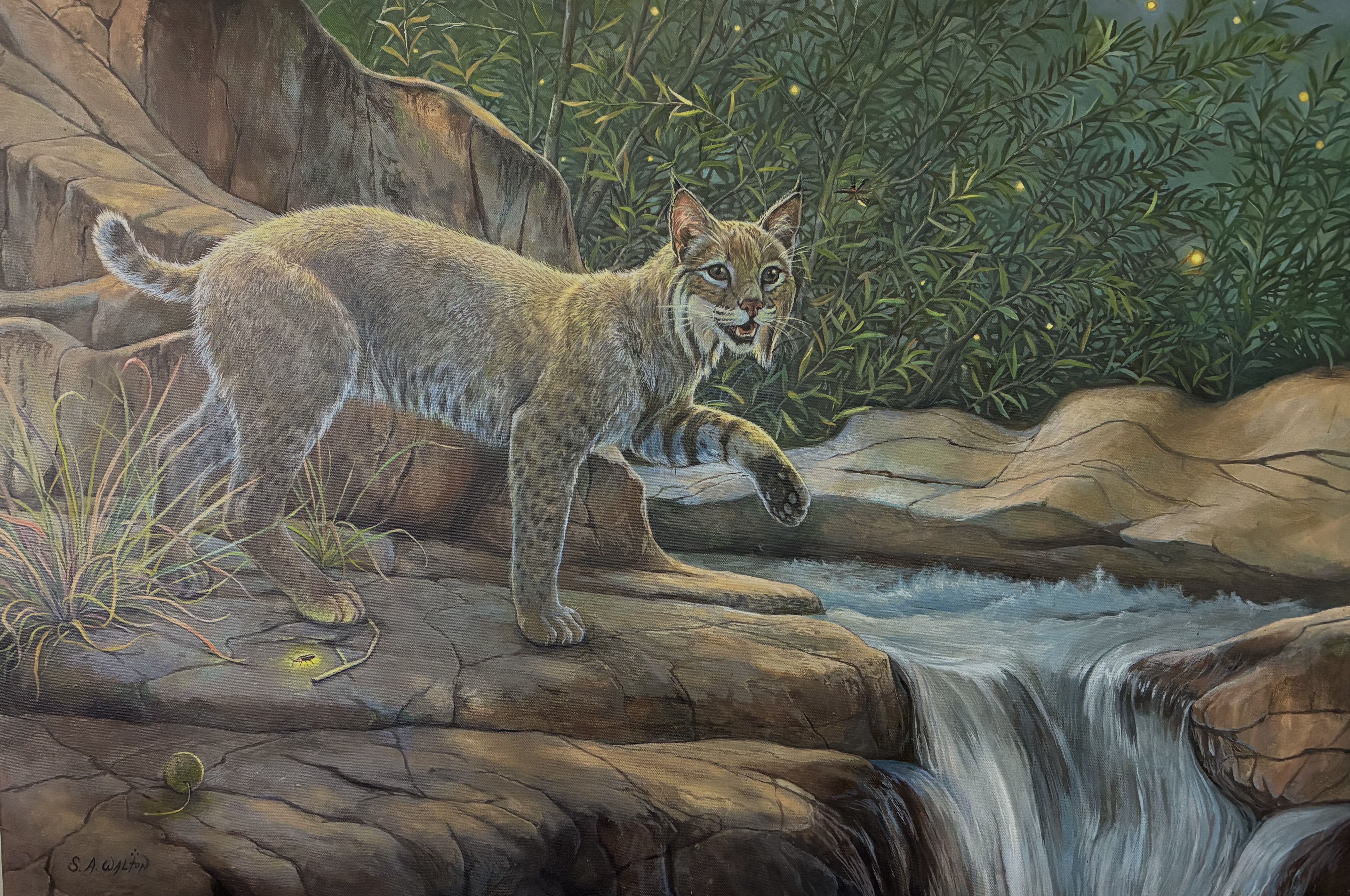
“Night Lights ~ Bobcat and Fireflies,” an original acrylic painting on stretched canvas, copyright Susan A. Walton of S. A. Walton Studio, Hudson, Florida.
In this painting entitled “Night Lights - Bobcat and Fireflies,” ancient igneous rocks such as those of the Castor River shut-ins in the St. Francois Mountains of Missouri are constrained with the smooth flow of the rushing water over the granite surface, which in daytime has a pink cast and is loaded with sparkling feldspar. A young bobcat, and lightning bugs, take center stage.
In the Midwest, we always referred to fireflies as lightning bugs, because … well, just because. It may be a regional term, but it makes more sense, in any case, than calling them a kind of fly. They are more beetle-like than they are fly-like, after all, and are never annoying. They are also more elegant in reality than they are in cartoons, where they are depicted with lightbulbs goofily screwed onto their backsides.
The fireflies we had in our pastures and woods were endowed with fine, reddish trim on their dark wing cases that always reminded me of the red trim on a U.S. Marine’s dress jacket. They also sport a dapper round black spot on their red carapace just back of the head. Even if they cannot light up your world like a Marine can, they are still be notable for their good looks.
Their luminescence comes from a little chemistry lab in the insect’s abdomen- gleaming from window-like panels in the underside, rather than a cartoonish bulb attached to the tip of their tail. In a dark woodland, or glade beneath the stars, the pulse of light the insect produces looks very intense. When present in the hundreds, they are truly a wonder to behold.
Fireflies also come in more than one species, each with their own special code of flashes that aid them in finding a mate of their own kind, and the color of the light varies a bit, too, depending on what species are present. The lightning bugs here in my part of Florida tend to look more like tiny blueish-white sparks going off quite far apart, as if they are speeding, while the pasture fireflies of Missouri let their powerful green lanterns pulse slowly and gently, but more frequently.
This painting is my attempt to capture a solitary, curious bobcat against a backdrop of well-worn and ancient igneous boulders that populate what was once a massive volcano. The extinct volcano was in the southeast part of the state of Missouri, in a geologically fascinating region also not far from an ancient seashore.
A small waterfall enhances the scene. You can imagine the rushing sound of water, and if you have a very good imagination, perhaps you can even imagine the amazing clean scent that whitewater rivers, especially trout streams and the swifter smallmouth bass creeks, seem to have.
The wildcat, illuminated by the dance of flashing fireflies seeking love among the willows, has probably come this way, lured by the sound of gurgling water, to drink from this refreshing source.
The scene is intended to capture both the curiosity of the young native cat, as well as these amazing insects. The lightning bugs look like those I often saw on early evening outings back when they were so incredibly abundant, a sight I hope will be experienced by children for generations yet to come… when they tire of the glow of cell phones.
I wonder if fireflies are still common in southeast Missouri. I haven’t been back there in many years, but have heard that numbers are down everywhere. It is theorized that they are declining because- in a world increasingly lit by inexpensive, unshielded, and mostly unnecessary lights- they cannot easily meet prospective mates amid the confusion.
In WW2 and for decades after those years of heightened concern for civil defense, exterior lighting was usually shielded from the top and sides; and so, neighborhoods did not seem as garish as they do today, where all such concern has been thrown away, and where people seem to be much more fearful and scared of the dark, trying to ward off the unknown with security lights.
The small signals emitted by the female fireflies as they position themselves in the weeds seeking flashy dates for an engaging night out, just can’t compete with all the artificial lights used today. The males are drawn away towards showy displays and electric porch lights, never completing the mission of producing a bright new generation, while the females are left to sit alone in the dark.
I am inviting you into a moment along the river when a curious young bobcat discovers for itself these delightful insects. The wild cat is not quite sure what to make of them, and seems poised to take a tentative swipe at one hovering near, or perhaps it has just paused from playfully batting the sycamore seed ball near its hind foot. I added that to the scene because American sycamore is a characteristic tree of rivers in Missouri’s southeast, and are especially common in the rocky shut-ins.
Hopefully, seeing this painting will remind folks to not leave their lights on from dusk to dawn in summer, and keep the early evenings dark for these living wonders, the humble lightning bugs.
#MissouriArt #Art #Fireflies #LightningBugs #WildlifePainting #Bobcat #AnimalArt #CurrentRiver
#ArtForSale #OriginalPainting #AcrylicPainting
- Medium
- Acrylic
- Substrate
- Canvas, cotton, stretched traditional
- Dimensions
- 24 x 36 x 3 in